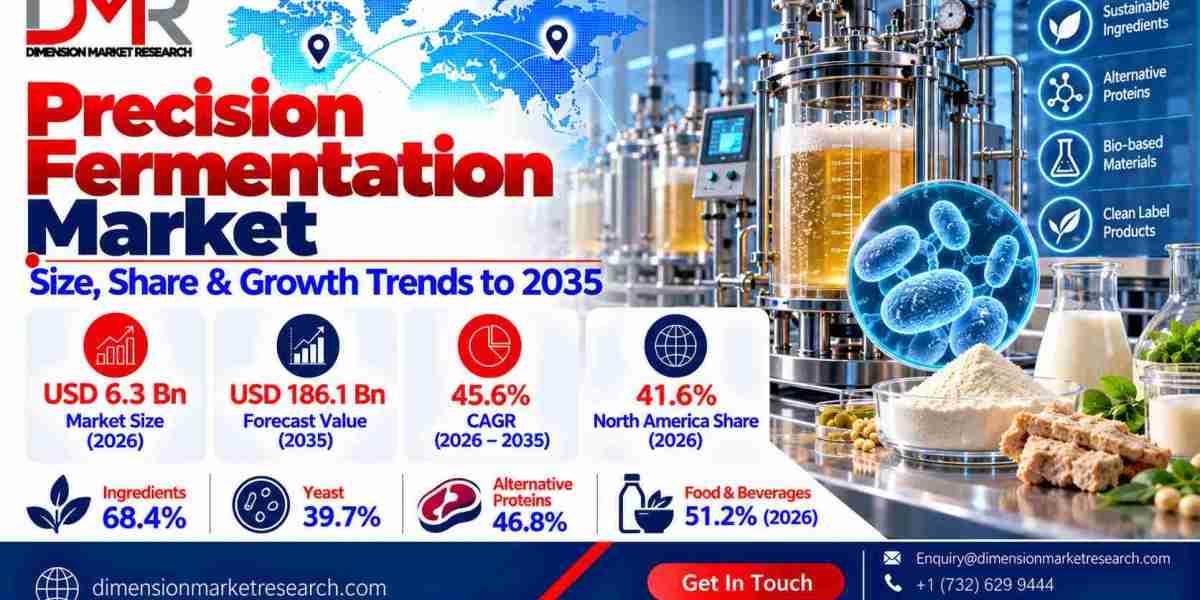

According to Dimension Market Research, the Precision Fermentation Market is projected to reach USD 6.3 billion in 2026 and USD 186.1 billion by 2035, registering a 45.6% CAGR. Demand for sustainable, animal-free ingredients and advances in synthetic biology support this forecast.
For ingredient manufacturers, food companies, and investors, the commercial question is how to connect that growth potential with a viable product. A market forecast establishes direction. An investment case needs a defined customer, a useful ingredient, and evidence that production can meet the intended requirements.
What Is the Precision Fermentation Market?
Precision fermentation uses engineered microorganisms to produce targeted substances, including proteins, enzymes, and functional compounds.
The important distinction for business readers is the intended output. Evaluating an ingredient requires attention to what it does in the customer’s product. A technically successful production process should therefore be assessed alongside the specifications and performance the buyer needs.
This provides a practical starting point for market assessment: identify the ingredient, define its application, and establish the evidence required for commercial acceptance.
Ingredient Demand Provides the First Commercial Focus
DMR projects ingredients to hold 68.4% of the product segment in 2026. Alternative proteins lead applications with 46.8%, while yeast leads microorganisms with 39.7%.
These findings suggest a useful analytical approach: examine product, application, and production organism together. Category leadership alone cannot establish whether a particular ingredient meets a buyer’s needs.
For a food manufacturer, the assessment should begin with a clear product brief. What function must the ingredient perform? Which characteristics are essential? What evidence would justify moving from a trial to a commercial agreement?
For a biotechnology supplier, answering those questions can help focus development and customer discussions. A specific application gives the commercial proposition a clearer foundation than a broad claim about sustainability.
Get a Free Sample of the Precision Fermentation Market Report
Review the sample to explore the report’s index, taxonomy, methodology, segmentation, and company-profile coverage. These materials can help strategy teams determine whether the complete study addresses their ingredient, application, and competitive research priorities.
https://dimensionmarketresearch.com/request-sample/precision-fermentation-market/
Regional Opportunity Requires a Local Commercial Plan
North America leads with an estimated 41.6% share in 2026. Asia Pacific is identified as the fastest-growing region.
For market-entry planning, these positions should prompt different lines of investigation. An established market calls for a precise explanation of differentiation. A growth opportunity calls for examination of customer access, production arrangements, and the capabilities needed to support expansion.
A useful regional assessment should specify which customers the supplier intends to serve and how the offering fits their requirements. It should also distinguish an attractive market from a market the business is ready to enter.
That discipline helps turn regional intelligence into a practical commercial plan.
Production Economics Remain Central to Evaluation
The report identifies production costs, infrastructure requirements, and approval challenges as constraints.
The analytical implication is to assess the complete commercialization proposal. Decision-makers should document production assumptions, identify outstanding technical questions, and establish what evidence is available at the proposed scale.
An investor’s assessment can ask whether development milestones correspond to customer requirements. A manufacturer’s assessment can examine how the proposed ingredient fits its product-development process.
These questions help separate demonstrated capabilities from objectives that still require validation. They also give partnerships a clearer purpose by identifying which capabilities each participant must contribute.
Competitive Landscape: Compare the Ingredient and the Delivery Plan
DMR lists Perfect Day, Geltor, The EVERY Company, Formo, Shiru, and Remilk among market participants. Competition centers on technology, intellectual property, research, and alliances.
For competitive benchmarking, compare offerings against the same application brief. Ask suppliers to explain their ingredient specifications, available evidence, production arrangements, and customer-support responsibilities.
This creates a more useful comparison than a company list alone. It also helps buyers identify where further information is needed before beginning a trial or negotiating a supply agreement.
Future Outlook: Connect Innovation With Customer Utility
DMR highlights AI-enabled bioprocessing and hybrid fermentation as development themes.
The practical question is what those capabilities change for the customer. An evaluation should ask which production or product requirement they address and how improvement would be demonstrated.
For suppliers, this encourages a focused commercial narrative: explain the customer problem, identify the relevant capability, and provide evidence of its usefulness. For investors, it offers a consistent way to assess progress.
Explore the Complete Precision Fermentation Market Analysis
Explore the complete study to assess its segmentation, regional coverage, and competitive profiles against your business objectives. Proceed to the verified checkout page to review license options and purchase details.
https://dimensionmarketresearch.com/checkout/precision-fermentation-market/
FAQs
1. What is the market size?
DMR projects USD 6.3 billion in 2026.
2. What is the forecast CAGR?
The reported CAGR is 45.6% for 2026 to 2035.
3. Which product segment leads?
Ingredients lead, with an estimated 68.4% share in 2026.
4. Which region leads?
North America leads, with an estimated 41.6% share in 2026.
5. What is the forecast value?
The market is projected to reach USD 186.1 billion by 2035.
Conclusion
The forecast supports closer examination of precision fermentation as an ingredient-production opportunity. Its commercial relevance depends on connecting innovation with a defined application, credible production assumptions, and customer evidence. Clear priorities can help businesses assess where to invest and whom to partner with.
Related Fermentation and Biotechnology Market Insights
The Microbial Fermentation Technology Small Molecules Market Size is projected at USD 40.4 billion in 2026, reaching USD 68.3 billion by 2035 at a 6.0% CAGR. Its coverage includes amino acids, organic acids, vitamins, and other fermentation-derived products, providing broader context for industrial biotechnology.
The Synthetic Biology Market Share analysis identifies North America as the leading region, with 43.2% revenue share in 2023. This report edition projects growth from USD 16.6 billion in 2023 to USD 89.9 billion by 2032 at a 20.6% CAGR, offering complementary context on biological engineering technologies.
The Singapore Alternative Protein Ingredients Market Growth outlook projects USD 68 million in 2026 and USD 151 million by 2035 at a 9.3% CAGR. Fermentation-derived protein is the fastest-growing source segment, with a reported 17.2% CAGR, highlighting a specific regional avenue for further research.