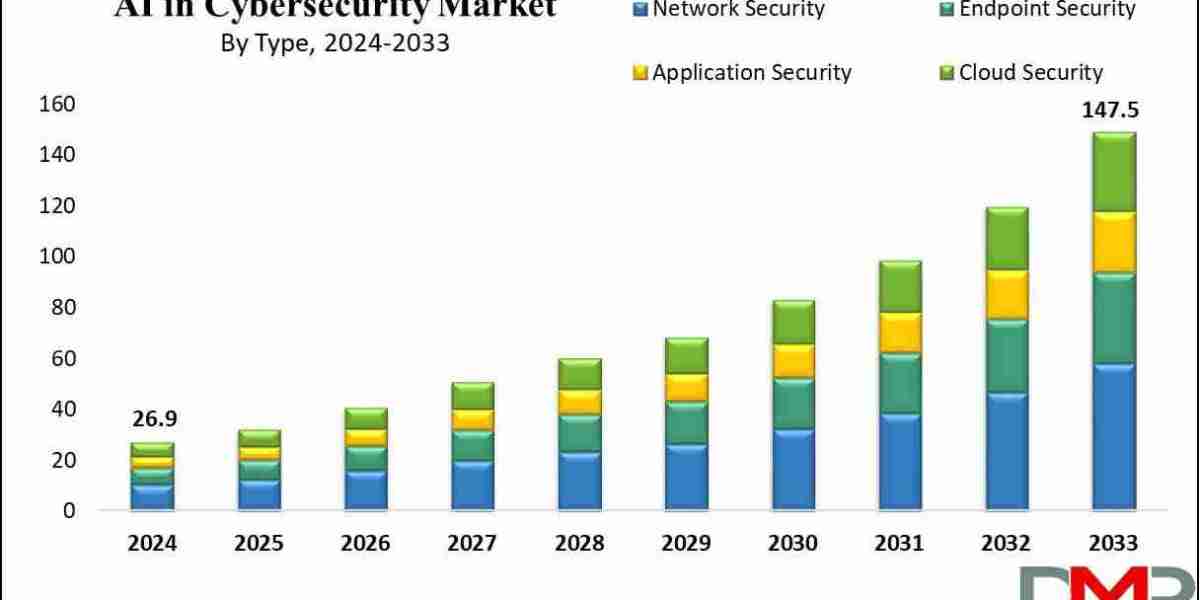

As cyberattacks become more sophisticated and digital infrastructures expand, organizations are increasingly turning to artificial intelligence to strengthen cybersecurity operations. The Artificial Intelligence in Cybersecurity Market reflects the growing demand for intelligent threat detection, automated response, fraud prevention, and proactive protection of enterprise networks. According to Dimension Market Research, the global market is estimated at USD 26.9 billion in 2024 and is projected to reach USD 147.5 billion by 2033, expanding at a compound annual growth rate (CAGR) of 20.8%.
AI is changing how organizations identify and respond to cyber threats. Traditional security systems often depend on predefined rules and known attack signatures. AI-powered platforms can analyze large volumes of security data, recognize unusual behavioral patterns, and help security teams identify suspicious activity more efficiently. These capabilities are increasingly relevant as businesses manage cloud environments, remote workforces, connected devices, and complex digital supply chains.
The market's expansion is also supported by the need to reduce response times, improve fraud detection, and manage growing volumes of security alerts. However, AI is not a replacement for established cybersecurity controls. Its value depends on reliable data, appropriate oversight, effective integration, and the ability to translate automated insights into actionable security decisions.
What Is the Artificial Intelligence (AI) in Cybersecurity Market?
The Artificial Intelligence (AI) in Cybersecurity Market encompasses technologies, software, hardware, and services that use artificial intelligence and machine learning to detect, prevent, investigate, and respond to cyber threats.
These solutions can analyze network traffic, identify suspicious login behavior, detect malware patterns, support fraud prevention, and help security teams prioritize incidents. Natural language processing can assist with analyzing security reports and threat intelligence, while machine learning can identify anomalies in large datasets.
The market includes network security, endpoint security, application security, and cloud security. It also covers applications such as identity and access management, risk and compliance management, data loss prevention, unified threat management, fraud detection, and threat intelligence.
Organizations across banking and financial services, healthcare, government, retail, manufacturing, and information technology are potential users. Their security priorities differ, but all face the challenge of protecting sensitive data and maintaining operational continuity in an increasingly connected environment.
Why Is the Artificial Intelligence (AI) in Cybersecurity Market Growing?
One of the primary growth drivers is the increasing complexity of cyber threats. Attackers continuously adapt their methods, making it difficult for organizations to rely exclusively on static security rules. AI-assisted monitoring can help detect deviations from normal behavior and identify potentially malicious activity earlier.
Cloud adoption and digital transformation are also expanding the number of systems that organizations must protect. Distributed applications, remote access, connected endpoints, and third-party integrations generate large amounts of security data. AI helps security teams analyze these signals and prioritize the incidents that require attention.
Fraud prevention represents another important application. Financial institutions and digital businesses can use intelligent analytics to examine transactions, detect unusual patterns, and flag potentially fraudulent behavior. Similarly, automated security analytics can help teams investigate alerts and coordinate incident response.
The shortage of experienced cybersecurity professionals adds another dimension to demand. AI-assisted tools can reduce repetitive analysis and support security operations teams, although human expertise remains important for interpreting results, managing exceptions, and making high-impact decisions.
Get a Free Sample of the Artificial Intelligence (AI) in Cybersecurity Market Report
Explore the market forecast, application opportunities, competitive environment, and major industry developments through the detailed research report.
https://dimensionmarketresearch.com/request-sample/artificial-intelligence-in-cybersecurity-market/
Key Market Statistics
● 2024 Market Size: USD 26.9 billion
● 2033 Forecast: USD 147.5 billion
● Forecast CAGR, 2024 to 2033: 20.8%
● Leading Type Segment: Network security, with a 39.3% share in 2023
● Leading Offering Segment: Services, with a 38.2% share in 2023
● North America Market Share: 39.1% in 2023
These figures reflect the estimates and segment findings published in the Dimension Market Research report. The base years for the market forecast and historical segment shares differ, so they should be interpreted accordingly.
Key Market Segments and Technology Trends
The Artificial Intelligence (AI) in Cybersecurity Market spans several technologies and security applications, each addressing different aspects of digital risk.
Network security is the leading type segment in the report's 2023 estimates, accounting for 39.3% of the market. This reflects the importance of protecting enterprise networks against unauthorized access, suspicious traffic, and evolving attack methods. Endpoint, application, and cloud security also remain relevant as organizations distribute workloads across devices and infrastructure environments.
By offering, services accounted for 38.2% of the market in 2023. These services can support implementation, integration, monitoring, consulting, and ongoing security operations. Their role is particularly important for organizations that need specialized expertise to deploy and manage AI-based cybersecurity systems.
Machine learning is identified as the leading technology segment, while fraud detection and anti-fraud is the leading application segment. BFSI, or banking, financial services, and insurance, is identified as the leading end-user segment in the report's 2023 analysis.
Several technology developments are shaping the market. Behavioral analytics can help identify unusual activity, while natural language processing can support threat intelligence analysis. Cloud-based security platforms can also help organizations monitor distributed environments. Increasingly, the strategic priority is to integrate these capabilities into existing security operations rather than deploy isolated tools that create additional complexity.
Regional Outlook: North America Leads Adoption
North America accounted for approximately 39.1% of the global Artificial Intelligence (AI) in Cybersecurity Market in 2023, according to the report. The region's established technology infrastructure, cybersecurity ecosystem, and adoption of advanced enterprise security solutions support its market position.
The United States and Canada are included in the report's North American coverage. Europe, Asia-Pacific, Latin America, and the Middle East and Africa are also covered.
Across these markets, demand is influenced by digital transformation, cloud adoption, data protection requirements, and the need to strengthen security operations. The specific pace of adoption will depend on organizational budgets, technical capabilities, regulatory environments, and the availability of skilled cybersecurity professionals.
Growth Opportunities and Market Challenges
One significant opportunity is the integration of AI into security operations centers. By helping teams correlate alerts, prioritize incidents, and analyze unusual behavior, AI-assisted systems can improve operational efficiency and support faster investigations.
Another opportunity lies in industry-specific security applications. Financial institutions need effective fraud detection and transaction monitoring, while healthcare organizations must protect sensitive patient information and maintain access to critical systems. Government agencies and manufacturers also face distinct security and operational requirements.
Despite these opportunities, adoption presents challenges. AI models can produce false positives, depend on the quality of training data, and require continuous monitoring. Organizations must also consider privacy, explainability, integration costs, and the risk of attackers exploiting weaknesses in AI-powered defenses.
Successful implementation therefore requires more than purchasing a tool. Businesses need clear security objectives, suitable data governance, trained personnel, human oversight, and measurable performance criteria. These factors will influence how effectively AI solutions deliver practical cybersecurity benefits.
Competitive Landscape
The competitive landscape includes established cybersecurity vendors and technology companies developing AI-enabled security products, analytics platforms, and threat detection capabilities. Competition centers on detection accuracy, automation, scalability, integration, and the ability to address evolving threats across enterprise environments.
Companies identified in the Dimension Market Research report include NVIDIA Corp, IBM Corp, Intel Corp, McAfee, Samsung Electronics, Micron Technology, Cylance Inc, Cisco System, Darktrace, and LogRhythm, among others.
Providers must balance innovation with reliability. Organizations evaluating solutions are likely to consider how well products integrate with existing infrastructure, whether they support their security and compliance requirements, and how effectively they help teams respond to incidents. The ability to combine intelligent analytics with actionable security workflows remains an important competitive consideration.
Explore the Complete Artificial Intelligence (AI) in Cybersecurity Market Analysis
Access detailed market forecasts, segmentation, regional coverage, and competitive insights to support strategic planning and investment decisions.
https://dimensionmarketresearch.com/checkout/artificial-intelligence-in-cybersecurity-market/
Frequently Asked Questions
1. What is the Artificial Intelligence (AI) in Cybersecurity Market size?
The market is estimated at USD 26.9 billion in 2024 and is projected to reach USD 147.5 billion by 2033.
2. What is the CAGR of the Artificial Intelligence (AI) in Cybersecurity Market?
The market is projected to grow at a CAGR of 20.8% from 2024 to 2033.
3. Which segment leads the Artificial Intelligence (AI) in Cybersecurity Market?
Network security led the type segment with a 39.3% share in 2023. Services led the offering segment with a 38.2% share in the same year.
4. Which region leads the Artificial Intelligence (AI) in Cybersecurity Market?
North America held the largest regional share, accounting for 39.1% of the market in 2023.
5. What is the future outlook for the Artificial Intelligence (AI) in Cybersecurity Market?
The market is projected to reach USD 147.5 billion by 2033. Demand for intelligent threat detection, fraud prevention, and automated security analysis is expected to remain important to its development.
Conclusion
The Artificial Intelligence (AI) in Cybersecurity Market is positioned for significant expansion as organizations respond to increasingly complex cyber threats and growing digital security requirements. Machine learning, network protection, fraud detection, and AI-assisted security operations are important areas of development.
North America's established market position and the growing use of AI across industries provide context for future opportunities. At the same time, organizations must address data quality, integration, privacy, and oversight to realize the benefits of intelligent security solutions. Providers that combine effective threat detection with reliable enterprise integration will be well positioned to address evolving cybersecurity needs.
Related Cybersecurity Market Insights
AI in Cybersecurity Market Size
The AI in Cybersecurity Market focuses on using artificial intelligence to improve threat detection, security analytics, fraud prevention, and incident response. Dimension Market Research estimates the market at USD 22.1 billion in 2023 and projects it to reach USD 115.0 billion by 2032, with a CAGR of 20.1%. These projections offer additional insight into the growing adoption of AI-driven cyber defense technologies.
The broader Cybersecurity Market encompasses solutions and services designed to protect digital infrastructure, enterprise systems, and sensitive information. The market is projected to reach USD 250.3 billion in 2026 and USD 564.1 billion by 2035, growing at a CAGR of 9.4%. North America is expected to account for 39.5% of global revenue in 2026.
US Cybersecurity Market Growth
The US Cybersecurity Market reflects demand for digital protection across businesses, government organizations, and critical industries. It is projected to reach USD 83.0 billion in 2026 and USD 177.8 billion by 2035, at a CAGR of 8.8%. Key areas of coverage include security solutions, services, cloud and on-premises deployment, and enterprise cybersecurity requirements.