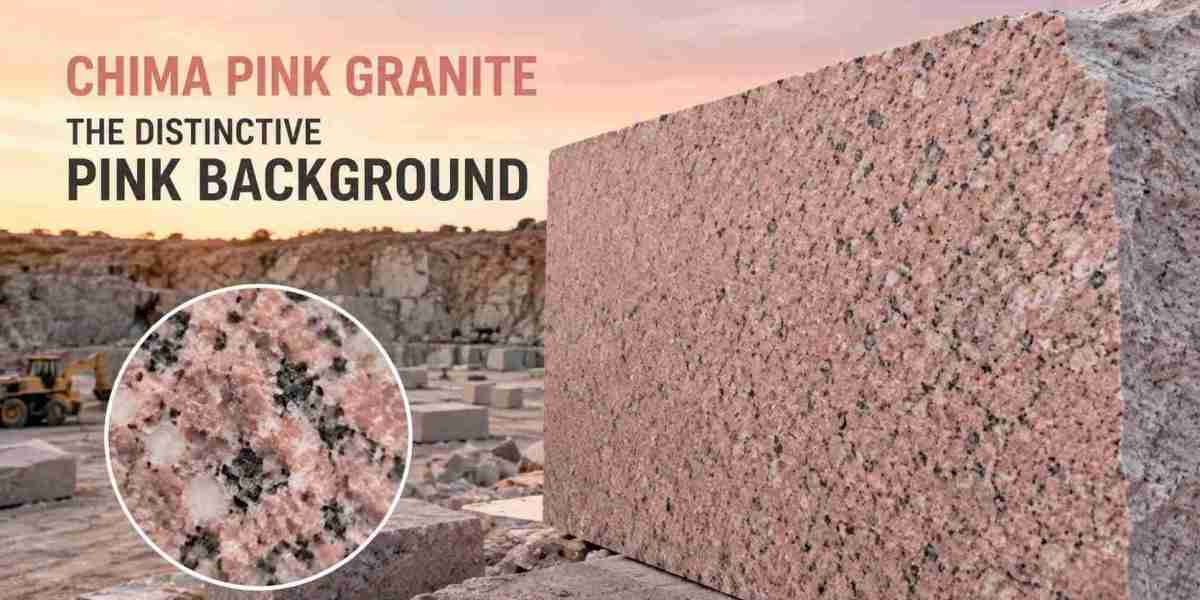

The defining feature of Chima Pink Granite slabs is the warm pink background that remains visible across the stone even when the surface is densely speckled with black, gray, white, or cream mineral grains. For US importers, fabricators, distributors, architects, and project buyers, that color is more than an aesthetic characteristic. It can influence slab matching, project consistency, block selection, fabrication expectations, and the way an entire shipment is evaluated.
Chima Pink Granite is commercially supplied from northern India and is commonly described as having a pink backdrop with contrasting dark and light mineral spots. Supplier and exporter references associate the material with the Jalore area of Rajasthan and offer it in rough blocks, slabs, tiles, and multiple finishes.
The key to its background color lies in the mineral makeup of the granite and, more specifically, in the proportion and visual character of its feldspar-rich grains. Understanding this relationship helps buyers distinguish expected natural variation from a batch that may not meet an approved appearance.
Why Chima Pink Granite Has a Pink Base
The pink background in granite is commonly associated with potassium feldspar, particularly pink varieties of orthoclase or microcline. Geological references identify pink potassium feldspar as a major contributor to the red or pink appearance of many granitic rocks.
In Chima Pink Granite, the visible effect is not simply a single pink mineral covering the entire stone. The background is created by the combined visual contribution of the major rock-forming minerals. The feldspar provides much of the warm base coloration, while quartz and other lighter minerals can soften or interrupt that color. Dark minerals create the contrasting black or gray spotting reported in commercial descriptions of the stone.
This explains why the stone can appear pink from a normal viewing distance while showing a much more complex structure when examined closely.
Feldspar controls much of the visual warmth
Potassium feldspar can range from pale pink to stronger reddish-pink tones. Its concentration, grain size, and interaction with other minerals affect the overall visual balance of a granite. Geological studies of pink granites similarly identify K-feldspar, plagioclase, and quartz as major components, with darker minerals providing additional contrast.
For a commercial buyer, the important point is that the pink background is a geological characteristic rather than a surface coating or artificial coloration.
Quartz and light minerals modify the background
Quartz is generally clear, grayish, or translucent in granite and does not normally create the dominant pink color. Instead, its presence can make the pink feldspar appear lighter, cooler, or more broken up visually. White or cream-colored feldspar and other lighter mineral grains have a similar effect.
This is why two Chima Pink Granite slabs can both meet the expected pink-color description while showing slightly different visual intensity.
Dark grains create the distinctive contrast
Commercial descriptions of Chima Pink Granite commonly mention black, gray, cream, and white speckling against pink.
The dark grains can create a salt-and-pepper effect within the pink field. Their concentration and distribution influence whether a slab looks relatively soft and uniform or more strongly patterned.
For designers and fabricators, this contrast is significant when large slab areas are placed side by side.
How Mineral Distribution Affects Chima Pink Granite Slabs
A granite slab is a two-dimensional exposure of a three-dimensional block. Consequently, the apparent pink background can change subtly from slab to slab depending on how the mineral grains are distributed through the block.
This is particularly relevant when sourcing rough granite blocks for a large US project.
Grain density can change perceived color
A slab containing a greater visual concentration of pink feldspar may appear warmer or more saturated. A slab containing more light quartz, cream-colored grains, or stronger dark spotting may appear lighter or more contrasted even though it belongs to the same commercial stone variety.
That distinction matters when buyers approve a small sample and later receive material from different blocks.
A sample should therefore be treated as a reference for an acceptable appearance range rather than an assumption that every production slab will look identical.
Grain size also affects the background
The same mineral proportions can produce different visual impressions depending on grain size. Fine, evenly distributed grains can make the pink background appear relatively continuous. Larger grains create more obvious visual interruptions and make mineral boundaries easier to see.
When reviewing Chima Pink Granite slabs, buyers should compare the grain scale as well as the general pink tone.
Block orientation can influence the visual result
A quarry block does not necessarily expose the same mineral arrangement on every face. The direction of sawing can change how grains and natural structures appear across the finished slabs.
For this reason, block photographs alone may not be sufficient for a major color-sensitive order. Slab photographs from the actual production batch provide much stronger evidence of the expected appearance.
Why Quarry Block Selection Matters to the Pink Background
The distinctive color visible in Chima Pink Granite begins with the selected block. Once a block has been extracted, the processing facility can improve surface presentation through cutting and finishing, but it cannot fundamentally change the stone's underlying mineral distribution.
Block selection therefore has a direct commercial connection to color consistency.
A suitable block for a specification-driven order should be assessed for:
- Overall pink background tone
- Distribution of black, gray, white, and cream grains
- Visible changes in grain size
- Natural fissures or open fractures
- Internal structural weaknesses
- Consistency across exposed block faces
- Expected slab yield
- Compatibility with previously approved material
A block with attractive color on one face can still produce a less consistent slab sequence if its internal structure changes significantly.
For large-volume purchasing, the objective should be to select blocks that fall within a defined visual range rather than simply choosing blocks that look attractive individually.
How Processing Can Change the Perception of Pink Chima Granite
Processing does not create the pink background, but it can change how strongly that background is perceived.
Polishing increases color clarity
Polished Chima Pink Granite slabs typically show greater surface reflectivity and more visual depth than unfinished material. The contrast between pink feldspar, lighter grains, and dark mineral spots becomes easier to see under direct lighting.
This makes polished samples useful for final appearance approval, especially for countertops, reception areas, hospitality interiors, and other applications where surface appearance is a primary consideration.
Honing produces a softer visual effect
A honed finish reduces surface reflection. As a result, the pink background may appear more subdued than on a polished slab.
A buyer comparing a polished sample against a honed production requirement should therefore avoid judging color solely by brightness. The mineral pattern itself should remain the main reference.
Flamed and textured finishes change the visual balance
Flamed, brushed, or bush-hammered finishes can create a rougher surface texture and scatter reflected light. These finishes may make the pink background appear less visually uniform than polished material.
For exterior or slip-resistant applications, finish selection should therefore be evaluated using the actual intended production sample rather than assuming the polished appearance will translate directly.
Commercial suppliers currently list Chima Pink Granite in polished, honed, flamed, leathered, brushed, bush-hammered, and other finishes, although available options vary by processor and order specification.
What US Buyers Should Check Before Approving a Chima Pink Granite Order
For a US importer or distributor, the most useful approach is to define the acceptable appearance before production rather than resolving color differences after arrival.
Request production-specific visual evidence
For a commercial order, request:
- Current photographs of the selected rough block
- Multiple views of the block rather than a single face
- Slab photographs from the actual production batch
- Close-up images showing mineral distribution
- Full-slab images under consistent lighting
- Video showing the slab sequence where practical
This is especially useful when a project requires several slabs to be visually coordinated.
Define the acceptable pink range
Avoid vague instructions such as "pink granite."
A purchase specification can instead describe the approved range in practical terms, such as:
Warm pink background with relatively consistent distribution of black, gray, white, and cream mineral grains, without significant unexpected changes between slabs.
The exact wording should reflect the approved sample and project requirements.
Check block-to-slab consistency
A supplier may provide attractive slabs from one block while another block in the same shipment exhibits a different balance of pink and contrasting grains.
For a large order, buyers should ask whether the shipment will be produced from one block, multiple blocks from the same working area, or unrelated blocks. This information can help establish realistic expectations for batch variation.
Approve actual thickness and finish
Thickness, calibration, edge work, polishing level, and surface finish should be confirmed separately from color approval. A slab can match the expected background color while still failing a dimensional or finishing requirement.
Some commercial listings for Chima Pink Granite show commonly available thicknesses around 2 cm and 3 cm, while thicker material and custom dimensions are also offered depending on the producer.
The contract or purchase order should always specify the required thickness rather than relying on a generic product description.
Natural Variation vs. Acceptable Commercial Consistency
The pink background of Chima Pink Granite should not be interpreted as a requirement for perfectly identical slabs.
Natural stone contains real mineral variation. Differences in grain size, mineral concentration, and local pattern distribution are expected. The commercial question is whether those differences remain within the appearance range approved for the project.
A useful distinction is:
Natural variation: Minor changes in pink tone, grain density, or dark mineral distribution that remain visually compatible with the approved sample.
Potentially unacceptable inconsistency: A significant change in background color, mineral pattern, grain character, or structural condition that makes the slabs unsuitable for the specified visual scheme.
For a hotel lobby, high-end commercial interior, or multi-unit development, even moderate shade differences may be more noticeable because large slab surfaces are installed next to one another. For less color-sensitive applications, a wider natural variation range may be acceptable.
Buyer Checklist for Chima Pink Granite Slabs
Before approving a commercial shipment, verify:
- The pink background range has been approved using actual production images or slabs.
- The selected rough granite blocks are visually consistent with the approved material.
- Black, gray, white, and cream mineral distribution is within the agreed range.
- The slab finish has been approved separately from the color.
- Thickness and dimensional tolerances are clearly specified.
- Any visible fissures or repairs are identified before shipment.
- Slabs are photographed or inspected before container loading.
- Packing is adequate to reduce breakage during international transportation.
- Shipment documentation identifies the agreed material, quantity, dimensions, and finish.
- Any project-critical shade requirement is included in the purchase specification.
This process is particularly valuable when dealing with a granite slab exporter & supplier for a container-scale purchase rather than a small sample order.
Why the Pink Background Matters Commercially
The appeal of Chima Pink Granite is closely tied to its recognizable pink field and contrasting granular pattern. That makes color consistency an important procurement issue for US buyers using the material across repeated countertops, staircases, flooring, wall applications, hospitality interiors, or other architectural elements.
The geological origin of the pink color also explains why perfect uniformity should not be expected. The same mineral system that gives the stone its character naturally creates variation between grains and, to some extent, between blocks.
For importers working with an Indian granite exporter, the most reliable sourcing strategy is therefore not to demand artificial uniformity. Instead, it is to define an acceptable appearance range, approve representative material, control block selection, and inspect the actual shipment before loading.
Conclusion
The distinctive pink background of Chima Pink Granite is primarily a result of its feldspar-rich mineral structure, with potassium feldspar playing a major role in the pink coloration of granite generally. Quartz, lighter minerals, and darker grains then modify the overall appearance, creating the characteristic pink field with contrasting speckles seen in commercial Chima Pink material.
For professional buyers, the practical lesson is straightforward: color consistency begins at the rough-block stage, not at final polishing. Careful block selection, production-specific slab approval, clear shade specifications, and pre-shipment inspection provide better control over Chima Pink Granite slabs than relying on a catalog photograph or a single sample.
For sourcing requirements, qualified buyers can request current block and slab photographs, available thicknesses and finishes, production details, packing information, and export quotations based on project quantity and specification.