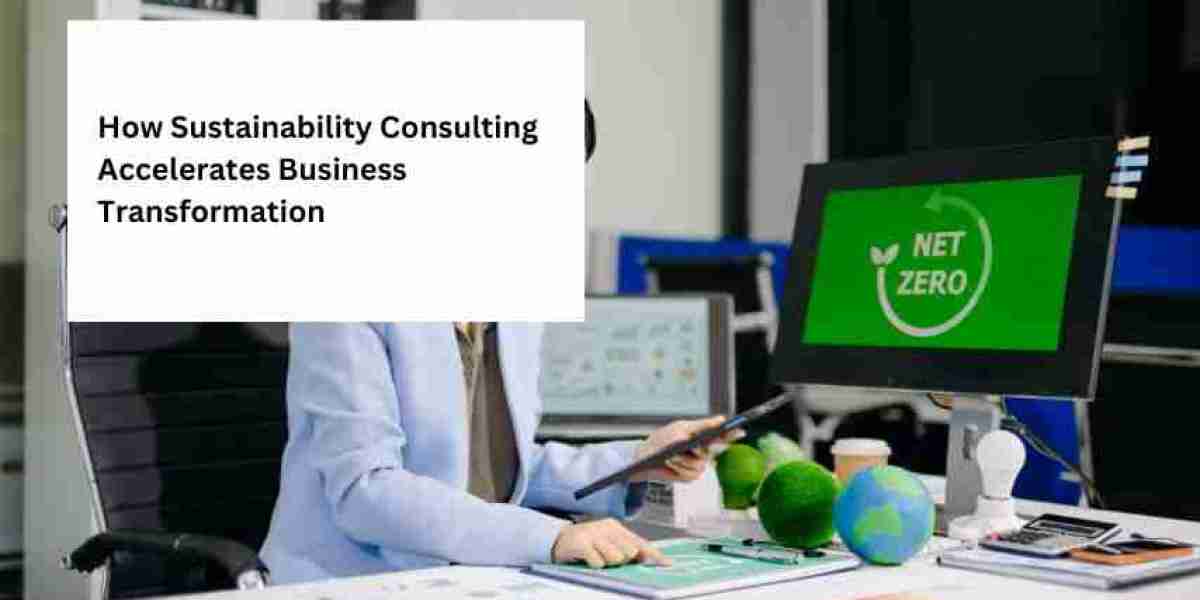

Business transformation is the process of changing how an organisation operates at a structural level, its systems, data, governance, and culture, rather than adjusting individual activities within an otherwise unchanged operation. Sustainability consulting is not usually the reason a company sets out to transform, but in Malaysia it is increasingly the trigger that turns transformation into an active project, because meeting a framework like Bursa Malaysia's National Sustainability Reporting Framework (NSRF) forces a company to confront gaps in data, governance, and cross-functional coordination it may have avoided addressing for years. This guide looks at how sustainability consulting accelerates broader business transformation, why it often moves faster than internally driven change programmes, and where the risks of that speed lie.
What Does "Business Transformation" Mean in a Sustainability Context?
In this context, business transformation means the structural changes an organisation makes to its systems, data infrastructure, governance, and internal culture, changes that outlast any single project, rather than a one-off improvement to a specific process.
How is this different from a sustainable business model?
Building a sustainable business model, covered in a separate guide, is about what a company sells and how it captures value. Business transformation is broader and more operational: it is about how the organisation runs internally, its data systems, decision-making structures, and culture, regardless of whether the underlying business model changes. A company can transform its internal operations significantly while still selling the same products in the same way.
What areas of a business does it typically touch?
Sustainability-driven transformation typically touches data infrastructure, since credible ESG reporting requires systems most companies did not previously have; governance, since sustainability oversight usually needs new committees or accountability structures; and culture, since sustainability targets only stick when staff outside the sustainability function understand and act on them. It frequently touches finance and procurement too, since sustainability data increasingly needs to connect to budgeting and supplier decisions.
Why Does Sustainability Consulting Accelerate Transformation Rather Than Just Add to It?
Sustainability consulting accelerates transformation because it arrives with an external deadline, a regulatory or buyer requirement, that gives internal change efforts a level of urgency and executive attention that purely internal initiatives often struggle to generate on their own.
Does it surface problems that were already there?
Yes, consistently. A materiality assessment or gap analysis frequently uncovers data gaps, disconnected systems, or unclear accountability that existed well before the engagement began, but that no one had been forced to address. Because the project has a clear external reference point, a regulatory deadline or a buyer's requirement, these pre-existing problems suddenly have a reason to be fixed now rather than indefinitely deferred.
Does it force cross-functional collaboration?
Generally, yes. Sustainability data and governance requirements rarely sit inside a single department; they touch operations, finance, procurement, HR, and sometimes IT simultaneously. A sustainability engagement often becomes the first project that requires these functions to share data and coordinate decisions in a structured way, which builds working relationships that tend to outlast the original engagement.
How Does Sustainability Consulting Drive Digital and Data Transformation?
Sustainability consulting drives digital and data transformation because credible ESG reporting is fundamentally a data problem: a company cannot disclose emissions, resource use, or supply chain data it has never captured in a structured, retrievable way.
What kind of systems does this typically require?
Meeting reporting requirements under the NSRF and IFRS S1 and S2 generally requires a company to move from ad hoc spreadsheets and manual data collection toward more structured systems for tracking energy, emissions, and resource use over time. Best sustainability consultants like Wellkinetics often recommend or help implement this infrastructure as part of a broader engagement, since disclosure quality depends directly on the consistency of the underlying systems.
Does this modernise other business systems too?
Often, yes, as a side effect rather than the original goal. Once a company builds better data infrastructure for sustainability purposes, the same systems and disciplines, consistent data definitions, regular reporting cycles, clearer ownership of specific metrics, tend to improve data quality and decision-making in adjacent areas such as operations and finance, even though those areas were not the original target.
How Does Sustainability Consulting Drive Organisational and Cultural Change?
Sustainability consulting drives organisational change by requiring companies to build governance structures and accountability that did not previously exist, and by giving staff outside the sustainability function a concrete reason to engage with targets that were previously someone else's responsibility.
Why do governance and accountability structures matter here?
Regulators, including Bursa Malaysia, expect sustainability oversight to sit clearly with the board and senior management rather than being delegated to a junior function. Building this structure, board-level committees, named accountability for specific targets, regular reporting lines into senior management, often becomes the first time a company has formalised decision-making this explicitly for any cross-functional issue, not only sustainability.
Does this change how staff think about their day-to-day work?
Over time, yes, though this shift is slower and harder to measure than the systems and governance changes. When operational staff start seeing energy, waste, or safety data tracked and discussed at management level, the same way financial metrics are, it tends to shift how they think about those issues in their daily decisions, from something handled elsewhere to something visible and connected to their own performance.
What Role Does Training Play in Sustaining Transformation?
Sustainability training plays a stabilising role: without it, the systems and governance structures a consulting engagement builds tend to depend heavily on the people who set them up, and risk reverting to old habits once the engagement ends.
Does training embed change beyond the consulting engagement?
Yes. Staff who understand why a new data system or governance process exists, not just how to operate it mechanically, are more likely to sustain and adapt it as circumstances change, compared to staff following an unexplained procedure. HRDCorp-claimable training makes this capability-building step more accessible for Malaysian companies, since it can be funded through the existing HRD Corp levy rather than as an additional cost layered on top of the consulting engagement.
Which teams benefit most from this training?
Staff in operations, finance, and procurement generally benefit most, since these are the functions most likely to be pulled into a sustainability-driven transformation without previously having sustainability as part of their role. Training that gives them enough regulatory and technical literacy to operate the new systems confidently is usually what determines whether the transformation holds after the consultant leaves.
What Are the Risks of Treating Sustainability as a Transformation Catalyst?
The main risks are overreach and change fatigue, since the urgency that makes sustainability consulting an effective transformation trigger can also push a company toward more structural change than it can absorb in one cycle.
Is there a risk of trying to change too much at once?
Yes. Because a sustainability engagement can surface many pre-existing problems simultaneously, data gaps, governance gaps, cross-functional friction, there is a temptation to fix all of them within a single project. Businesses generally fare better prioritising the changes most directly tied to the immediate reporting or compliance requirement first, and treating broader transformation as a longer sequence rather than a single overhaul.
Does repeated transformation activity cause fatigue among staff?
It can, particularly if staff experience sustainability-driven change as a series of disconnected demands rather than a coherent direction. Consulting and training that clearly connect each change to a specific, understood purpose tend to generate less resistance than change introduced without that context, which is one reason training alongside consulting matters more here than in a purely technical engagement.
What Does the Evidence Say About This Pattern in Malaysia?
Direct evidence on sustainability-driven transformation specifically is limited, but related survey data supports the general pattern. In a survey of 610 Malaysian SMEs conducted by Alliance Bank Malaysia with UN Global Compact Network Malaysia and Brunei and SME Corporation Malaysia, most companies that had adopted ESG practices had done so only within the past five years, meaning the systems and governance changes many businesses are now building are still recent, consistent with sustainability acting as a relatively new catalyst for broader change rather than an established, mature process.
SME Corporation Malaysia's continued expansion of simplified ESG guidance, and Malaysian Green Technology and Climate Change Corporation (MGTC) findings that limited technical knowledge remains a leading barrier to adoption, both point toward the same conclusion: many Malaysian businesses are earlier in this transformation process than the pace of regulatory and buyer expectations might suggest, which is precisely where consulting and training have the most to offer.
Conclusion
Sustainability consulting accelerates business transformation less because it sets out to change everything at once, and more because it arrives with an external deadline that gives long-deferred structural problems, weak data systems, unclear governance, siloed teams, a genuine reason to be fixed now. The clearest gains tend to come from data infrastructure and governance, areas that sustainability reporting depends on directly, with cultural change following more slowly as staff see those systems used in practice. Training determines whether this transformation holds once the consulting engagement ends, since systems and governance structures built without internal understanding tend to erode. Businesses that treat sustainability as one entry point into a longer, prioritised transformation process, rather than a single project meant to fix everything at once, are the ones most likely to turn regulatory pressure into lasting organisational change.
References
- Bursa Malaysia Securities Berhad. National Sustainability Reporting Framework and Sustainability Reporting Amendments. bursamalaysia.com
- SME Corporation Malaysia. ESG Quick Guide for MSMEs. smecorp.gov.my
- Malaysian Green Technology and Climate Change Corporation (MGTC). ESG study findings to help SMEs enhance their ESG journey. mgtc.gov.my