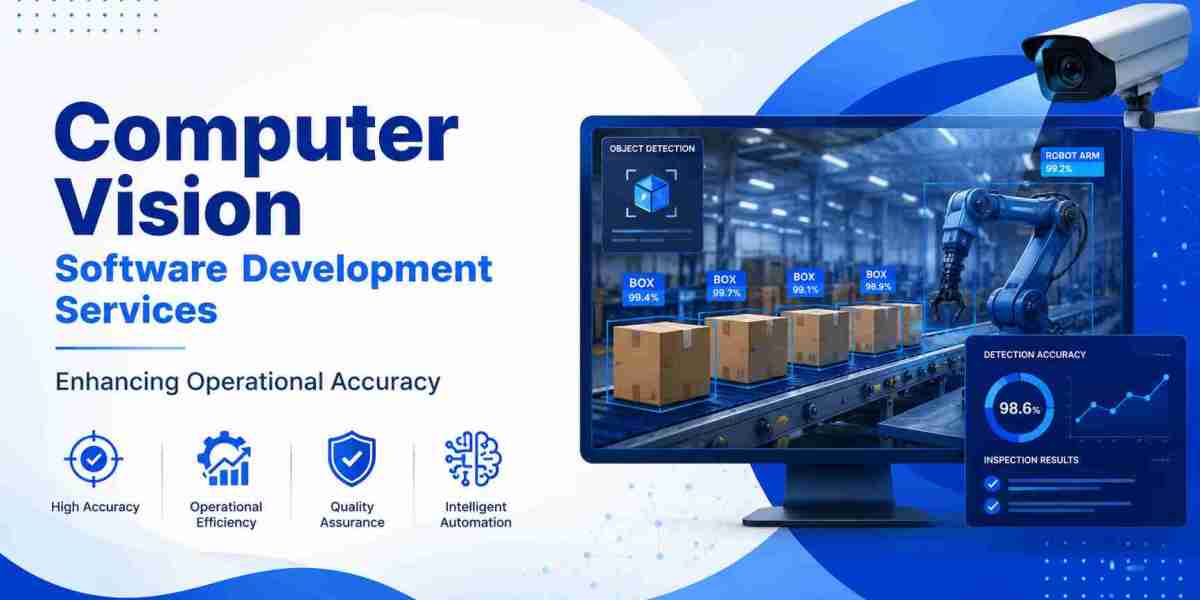

Humans are remarkably good at a lot of things. Spotting the same defect on the four-hundredth item of an eight-hour shift is not one of them. Fatigue sets in, attention drifts, and even the most diligent inspector starts missing things by mid-afternoon that they'd have caught instantly that morning. This isn't a character flaw — it's just how human attention works under repetitive conditions. Business owners running anything involving visual inspection, counting, monitoring, or quality checks have been quietly absorbing the cost of this limitation for years, often without realizing how much it's actually adding up. Computer vision changes that equation entirely, and it's doing so at a level of accuracy and consistency that simply wasn't commercially viable even five years ago.
What makes this technology worth serious attention right now isn't novelty — it's that the accuracy gains are measurable, fast to prove out, and directly tied to costs every operations-focused business owner already cares about: waste, rework, returns, safety incidents, and the slow erosion of customer trust that comes from inconsistent quality.
Where Manual Inspection Quietly Costs You the Most
Every business with a physical product or process has at least one point where accuracy depends entirely on a person looking carefully and making a judgment call in real time. A production line worker checking for surface defects. A warehouse team counting inventory by hand. A retail manager walking the floor to spot misplaced stock or empty shelves. These tasks feel manageable in isolation, but stacked across thousands of repetitions a day, the error rate becomes a real and recurring cost rather than an occasional inconvenience.
The tricky part is that these costs rarely show up as one obvious line item. They're scattered across customer complaints, returned products, safety incident reports, and inventory discrepancies that get written off as "shrinkage" without anyone tracing the root cause back to where the original error happened. Computer vision systems excel precisely because they don't get tired, distracted, or inconsistent across a shift — they apply the same standard to the first item and the ten-thousandth.
- Defect rates that increase measurably as human inspectors fatigue over a shift
- Inventory discrepancies traced back to manual counting errors at scale
- Safety violations missed due to limited human monitoring coverage
- Customer-facing quality issues that erode trust before anyone identifies the cause
Mapping where these costs actually live in your own operation is usually the first step toward identifying which process would benefit most from a vision-based upgrade.
How the Technology Actually Earns Its Keep
Without getting lost in technical jargon, it helps for business owners to understand roughly what's happening so they can have an informed conversation with any potential partner. A camera captures visual data continuously, and a trained model analyzes that data in real time, comparing what it sees against patterns it's learned from thousands of prior examples — what a defect looks like, what a properly stocked shelf looks like, what unsafe behavior near machinery looks like. When something doesn't match the expected pattern, the system flags it instantly, often faster and more consistently than a human ever could.
The accuracy of this entire system depends heavily on how well it was trained and tuned for your specific environment. A model trained on generic data won't perform nearly as well as one trained specifically on your products, your lighting conditions, and your actual edge cases. This is exactly why the underlying engineering work matters so much more than the marketing pitch around the technology itself.
- Real-time visual analysis that flags anomalies the moment they occur
- Pattern recognition trained specifically on your products and environment
- Continuous learning that improves accuracy as more real-world data is captured
- Integration with existing systems to trigger automatic alerts or actions
Business owners evaluating this technology should care less about flashy demos and more about whether a partner can demonstrate accuracy improvements specific to a use case that actually resembles their own.
What Belongs in a Genuinely Solid Build
A surprising number of vision projects underdeliver not because the underlying technology failed, but because the build itself skipped steps that mattered. Proper Computer vision software development involves far more than training a model and connecting it to a camera feed — it requires careful data collection and labeling specific to your operation, rigorous testing across the actual lighting and environmental conditions your business deals with daily, and a feedback loop that keeps the model improving as it encounters new edge cases over time. Rushing past any of these stages tends to produce a system that performs well in a controlled pilot and then disappoints once it meets the messiness of a real operating floor.
The businesses that get strong, lasting results treat this as an iterative engineering process rather than a one-time installation. Initial accuracy numbers from a pilot phase are a starting point, not a final result, and a properly built system should visibly improve over its first few months in production as it's exposed to more real-world variation.
- Custom data collection and labeling tailored to your specific operation
- Testing across real lighting, angle, and environmental variability, not just ideal conditions
- Ongoing model refinement based on production performance, not a one-time deployment
- Clear accuracy benchmarks defined and tracked before and after rollout
Asking a potential partner to walk through exactly how they handle each of these stages reveals far more about likely success than any case study slide ever will.
Choosing a Partner Who's Actually Done This Before
Vision technology has enough moving parts — hardware selection, model training, integration with existing systems, ongoing maintenance — that picking the wrong partner can cost months of wasted effort before anyone notices the project isn't on track. A genuinely capable Computer vision development company brings prior experience specifically with use cases similar to yours, not just general machine learning credentials that sound impressive but don't translate directly to your particular accuracy and reliability requirements. Manufacturing quality control, retail shelf monitoring, and safety compliance monitoring are all computer vision applications, but they demand meaningfully different expertise, hardware considerations, and tuning approaches.
References matter enormously here, more than in most other technology categories, because the gap between a company that's deployed five similar systems successfully and one that's attempting its first is usually visible the moment something unexpected happens in your specific environment.
- Prior experience in your specific industry or a closely comparable use case
- Honest conversations about realistic accuracy expectations, not inflated promises
- Clear plans for hardware selection and installation, not just software delivery
- Willingness to start with a contained pilot before a full-scale rollout
A short, well-scoped pilot remains the single best way to evaluate whether a partner's claims hold up against your actual operating conditions before committing to a larger investment.
Engaging the Right Way for Your Stage and Budget
Not every business needs the same depth of engagement, and understanding the range of available Computer vision development services helps business owners avoid either overpaying for more than they need or underinvesting in a way that quietly limits results later. Some businesses benefit most from a fully custom build designed entirely around their specific environment and edge cases. Others get strong results from adapting existing, pre-trained models to their use case, which moves faster and costs considerably less when the application is fairly standard, like basic object counting or generic defect categories.
The right path depends on how unusual your specific problem actually is, and a trustworthy partner will tell you honestly which category your project falls into rather than defaulting to whichever approach maximizes their own billing. Business owners should be wary of any vendor who pushes a fully custom build for a problem that's already been solved well by existing frameworks.
- Custom builds suited to genuinely unique products or unusual operating environments
- Adapted pre-trained models offering faster, lower-cost results for standard use cases
- Phased engagements that prove value on one process before expanding further
- Pricing models that scale with project complexity rather than one-size-fits-all rates
Matching the engagement type to the actual complexity of your problem is often the single biggest factor in getting a strong return on this investment.
Building Long-Term Capability Instead of One-Time Dependency
Some businesses, particularly those where visual inspection sits at the core of their entire operation, eventually reach a point where it makes sense to build internal capability rather than relying entirely on outside support for every new use case. For these companies, the smarter long-term move is often to Hire Computer Vision Developers directly, creating an internal team that deeply understands the company's specific products, facilities, and operational quirks in a way that's harder for an external partner to replicate fully over time. This path requires patience and real investment, but it pays off through faster iteration once the internal team is up to speed, since every new use case doesn't require renegotiating an external engagement from scratch.
The trade-off is straightforward: building this capability internally takes longer to show results and demands a genuine commitment to ongoing training, since the field continues to evolve quickly. Many businesses find a hybrid model works best in practice — a small internal team handling day-to-day refinement and monitoring, supported by an external partner for major new builds or specialized challenges that exceed internal bandwidth.
- Deeper institutional knowledge of your specific operational environment over time
- Faster iteration on new use cases without renegotiating external engagements
- Higher upfront investment and longer ramp-up compared to outsourced projects
- Hybrid models combining internal teams with external expertise for major builds
Whichever path a business chooses, the underlying goal stays the same: turning visual inspection from a source of quiet, recurring error into a source of consistent, measurable accuracy that compounds in value the longer the system runs.