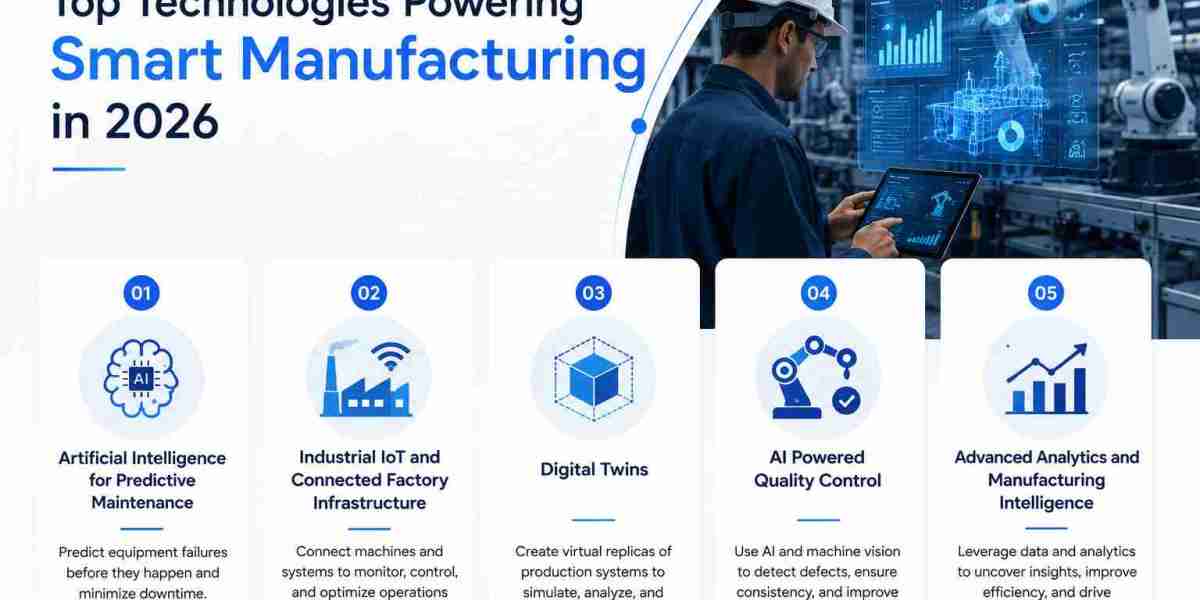

Manufacturing is going through one of the biggest changes in its history. The factories pulling ahead are not just automating tasks. They are building smarter operations that learn and improve on their own.
Smart manufacturing is no longer something only large companies with big budgets can afford. In 2026, the technologies that power intelligent factories are more accessible and more proven than ever before. According to a 2025 Deloitte report, 86 percent of manufacturing executives believe smart factory initiatives will be the main driver of competitiveness over the next five years.
But knowing which technologies actually deliver results is where most manufacturers struggle. Here is a straightforward look at the technologies making a real difference on factory floors in 2026.
1. Artificial Intelligence for Predictive Maintenance
Unplanned downtime is one of the most expensive problems in manufacturing. A single line stoppage can cost thousands of dollars per hour. Traditional maintenance schedules, where equipment is serviced at fixed intervals, do not solve this. They just manage it.
AI powered predictive maintenance is a much smarter approach. Sensors on machines continuously monitor things like vibration, temperature, and pressure. AI models analyse this data in real time and spot patterns that point to a failure before it actually happens. Maintenance teams get an alert days or even weeks ahead of time, so they can fix things when it is convenient rather than scrambling after a breakdown.
How businesses are using it today
Manufacturers investing in Custom AI/ML Solutions for predictive maintenance are seeing real reductions in unplanned downtime. They are also getting more life out of their equipment by servicing it only when it actually needs attention, rather than following a fixed calendar schedule that may be too early or too late.
2. Industrial IoT and Connected Factory Infrastructure
The foundation of any smart factory is connectivity. Machines, sensors, and production lines that cannot share data cannot be improved together. Industrial IoT solves this by connecting every part of the factory floor to a central system, giving operations teams a live picture of everything happening across the site.
In 2026, connected factory infrastructure goes well beyond basic monitoring. IIoT networks are tracking energy use at the individual machine level, monitoring conditions across production zones, and feeding real time quality data into process control systems. According to a 2025 McKinsey report, manufacturers with fully connected factory infrastructure report 20 to 30 percent improvements in overall equipment effectiveness.
Combining connectivity with AI
Working with providers of ai & ml development solutions who also understand industrial connectivity allows manufacturers to build systems that do not just collect machine data but actively use it to make better production decisions in real time. The two capabilities work much better together than either does on its own.
3. Digital Twins
A digital twin is a virtual copy of a physical asset, production line, or entire factory. It mirrors what is happening in the real world, updated continuously by sensor data, and allows teams to test changes and simulate outcomes without touching the actual production environment.
In simple terms, a manufacturer can try out a new production schedule before implementing it, test the impact of a process change on quality and speed, or model how a new piece of equipment will perform before it even arrives. All of this happens virtually, with none of the cost or risk of real world trials.
Where this technology stands in 2026
According to Gartner, by 2026 over 65 percent of large manufacturers will have deployed digital twins of at least one production process, up from around 35 percent in 2023. It has moved from an experimental idea to a practical operational tool in a very short time.
4. AI Powered Quality Control
Quality control has always been labour intensive. Human inspectors are effective but they get tired, they are inconsistent, and they cannot keep up with high speed production lines without becoming a bottleneck themselves.
AI powered visual inspection systems change this completely. Computer vision models trained on thousands of images of good and defective products can inspect items at full production speed, flagging defects more consistently than any human team could manage. These systems work around the clock and get better over time as they see more data.
Why custom models outperform generic ones
Manufacturers working with custom ai development services to build inspection models trained on their own products and defect types see much better results than those using generic off the shelf solutions. The AI understands what a defect looks like in their specific context, which means fewer missed defects and fewer false alarms.
5. Robotics and Collaborative Automation
Industrial robots have been part of manufacturing for a long time, but the robots being used in 2026 are very different from earlier generations. Collaborative robots, known as cobots, are designed to work alongside people rather than replace them. They are safer, easier to programme, and flexible enough to be moved to different tasks as production needs change.
Why flexibility matters more than ever
Modern manufacturing involves more product variety and smaller batch sizes than it did ten years ago. A cobot that can be reprogrammed in a few hours to handle a different product is far more useful than a fixed automation system that takes weeks of engineering work to reconfigure. This flexibility is one of the main reasons cobot adoption has grown so rapidly across mid-sized manufacturers in particular.
6. Custom IoT Solutions for Process Optimisation
Off the shelf IoT platforms cover a lot of ground, but manufacturing environments are rarely standard. Legacy equipment, unusual process requirements, and specific safety constraints mean that the most effective connected factory setups are often built specifically for one operation rather than adapted from a generic platform.
When a custom build makes more sense
This is where Custom IoT Development Solutions make a real difference. A custom IoT build designed around a manufacturer's specific equipment and processes works properly from day one. For manufacturers running a mix of modern and older equipment, custom IoT development also solves the connectivity problem that generic platforms often cannot, bringing legacy machines into the connected factory without needing to replace them entirely.
7. Edge Computing for Real Time Decisions
Many of the most time sensitive decisions in manufacturing, such as quality checks, safety responses, and process adjustments, cannot wait for data to travel to a cloud server and back. Edge computing solves this by processing data locally, right where it is generated, and acting on it in milliseconds.
How it works alongside cloud systems
In 2026, edge computing has become a standard part of smart factory design, particularly in high speed production environments. Edge devices handle the time critical processing locally while sending summarised data to the cloud for longer term analytics and reporting. It is not a choice between edge and cloud. Both have a role and the best setups use them together.
8. Advanced Analytics and Manufacturing Intelligence
Smart manufacturing generates a huge amount of data. The challenge is not collecting it but making sense of it fast enough to act on. Advanced analytics platforms designed for manufacturing translate raw operational data into clear insights about where efficiency is being lost and where the biggest opportunities for improvement are.
Turning data into action
In 2026, the best manufacturing analytics platforms use AI to surface these insights automatically rather than waiting for an analyst to investigate. Problems are flagged, likely causes are suggested, and improvement opportunities are ranked by potential impact. Manufacturers that have invested in custom iot development services alongside strong analytics capabilities are getting the most out of this combination, because good analytics output depends on good data coming in from the factory floor.
9. Supply Chain Visibility and AI Forecasting
Supply chain disruption has been a consistent challenge for manufacturers over the past several years. AI forecasting tools are helping businesses see further ahead, predicting demand changes, spotting potential supply problems before they arrive, and optimising stock levels to avoid both shortages and excess inventory.
Real time visibility across the supply chain
Real time supply chain platforms connect manufacturers with their suppliers and logistics partners, giving a live picture of where materials are and when they will actually arrive. This means procurement and production teams can respond to problems early rather than reacting when it is too late to avoid disruption.
10. Cybersecurity for Connected Manufacturing
As factory floors become more connected, they also become more exposed to cyber threats. A manufacturing environment that was previously isolated from external networks is now connected to cloud platforms, supplier systems, and remote monitoring services. Each connection is a potential vulnerability.
Why manufacturing cybersecurity is different
Protecting operational technology in a factory is not the same as standard IT security. Industrial systems have different requirements, different update schedules, and different constraints. In 2026, manufacturers investing in smart factory technology are increasingly treating cybersecurity as a foundational requirement that gets built in from the start, rather than something added on later when a problem occurs.
Final Thought
Smart manufacturing in 2026 is not about deploying every technology available. It is about picking the right combination of connected infrastructure, AI intelligence, and automation that fits the specific challenges of your operation.
The manufacturers getting the best results started with a clear problem, chose technology that addressed it directly, and built from there. The technologies in this article are the ones that are making the most measurable difference right now. What matters is how thoughtfully they are applied.