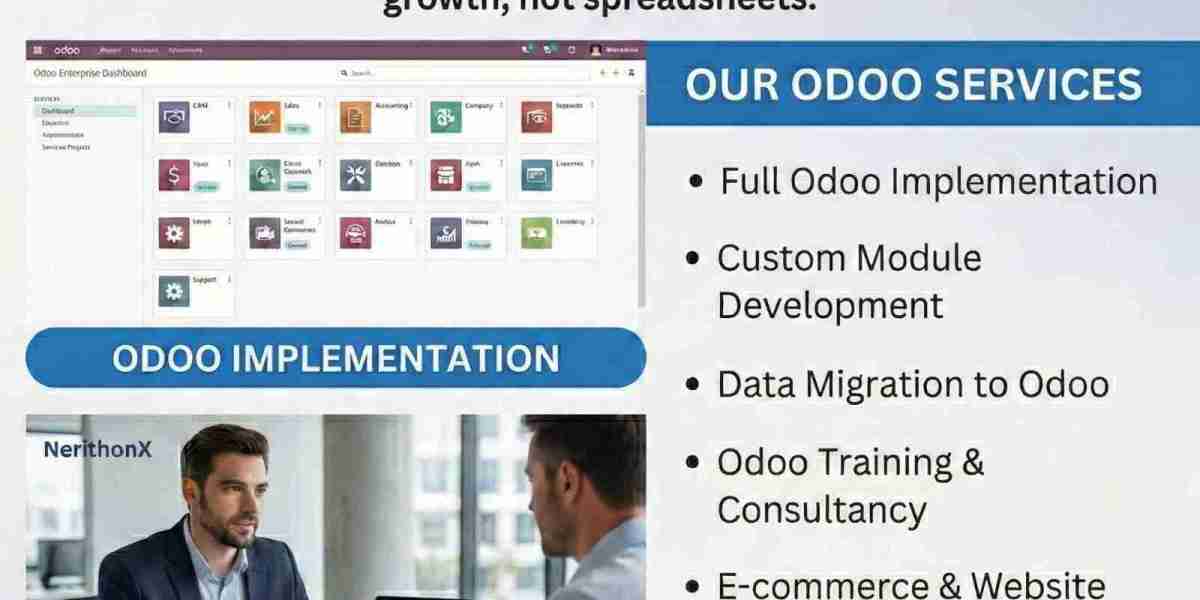

Why Choose Odoo ERP Implementation Services for Business Automation?
In 2026, businesses that still rely on disconnected spreadsheets, multiple logins, and manual data entry are losing time and money every single day. True automation means processes run smoothly without constant human intervention — invoices generate themselves, stock levels trigger reorders, sales data flows straight into accounting. Odoo ERP delivers exactly that kind of intelligent automation, but only when implemented correctly. That’s why more growing companies are turning to professional Odoo ERP implementation services instead of attempting a DIY setup or continuing with outdated legacy systems. Done right, Odoo becomes the central nervous system of your business — unifying departments, eliminating silos, and freeing your team to focus on growth rather than repetitive tasks.
Reason 1: Dramatically Lower Total Cost of Ownership
Traditional enterprise ERPs often demand six- or seven-figure budgets before you even see value. Odoo changes the economics completely. The Community edition is free forever, and even the Enterprise version charges a reasonable per-user fee that scales naturally with your team size. Professional implementation services help you avoid expensive mistakes — like over-customizing too early, buying unnecessary add-ons, or choosing modules that don’t fit your real needs. Most clients discover they achieve full business automation at 40–70% less cost compared to SAP, Oracle NetSuite, or Dynamics 365. A well-planned Odoo project typically delivers strong ROI within the first 6–12 months.
Reason 2: Native, Deep Integration Across Every Function
The real magic of Odoo lies in how tightly its 50+ modules work together out of the box. When a quotation turns into a confirmed sale, inventory updates instantly, a delivery order is created, an invoice is generated automatically, revenue posts to accounting, and commissions calculate — all without anyone manually moving data. This level of native integration is what powers powerful automation: low-stock alerts, automated purchase orders, payment reminders, timesheet-to-invoice flows, and more. Implementation partners configure these automations to match your exact business rules, so the system feels custom-built even though you’re using standard, upgrade-safe features. Fragmented tools simply cannot deliver this seamlessness.
Reason 3: Truly Modular and Future-Proof Design
Unlike rigid ERPs that force you to buy everything or require painful replatforming later, Odoo lets you start small and grow intelligently. Begin with CRM, Sales, and Accounting if you’re a service business. Add Inventory, Purchase, and Manufacturing when you scale physical operations. Activate Field Service, eCommerce, or HR Payroll only when you’re ready. Certified Odoo partners create a clear phased roadmap so you see quick wins early while building a foundation that expands without disruption. With Odoo’s frequent major releases (bringing AI enhancements, better mobile experience, stronger analytics, and more in 2026), your automation stays modern without expensive rip-and-replace projects.
Reason 4: Modern Interface That Actually Gets Used
One of the biggest reasons legacy ERPs fail is terrible user adoption — employees hate the clunky interface and revert to Excel. Odoo’s clean, intuitive design feels more like a modern SaaS app than traditional enterprise software. Drag-and-drop builders, mobile-friendly views, consistent navigation, and role-based dashboards make daily work faster and less error-prone. Professional implementation includes tailored training, custom starter screens, and guided workflows so your team embraces the system instead of resisting it. Higher adoption means cleaner data, which in turn powers more reliable and intelligent automation across the business.
Reason 5: Open-Source Flexibility + Thriving Ecosystem
Being fully open-source gives Odoo unmatched long-term flexibility. Need a very specific field, report, or workflow? Developers can extend any module without licensing restrictions or vendor approval. The Odoo App Store offers thousands of free and paid extensions for niche industries — retail POS, healthcare patient management, education enrollment, construction job costing, and many more. Implementation partners know which apps add real value and how to integrate them cleanly. They also connect Odoo to external tools you already use (Shopify, payment gateways, shipping carriers, WhatsApp Business, custom APIs) so your automation ecosystem grows naturally.
Reason 6: Real-Time Insights and Smarter Decision-Making
Automation isn’t only about speed — it’s about intelligence. Odoo provides live dashboards, pivot tables, forecasting tools, and KPI tracking across every department. See cash flow, pipeline health, stock trends, project profitability, or employee performance in real time — no more waiting for end-of-month reports. Recent versions include AI-powered suggestions, anomaly detection, and predictive reorder recommendations. Expert implementers configure these insights around your most important metrics, turning raw data into automatic triggers (e.g., escalate slow-moving leads, adjust safety stock based on sales velocity). Better visibility leads to faster, more confident decisions.
Reason 7: Faster Go-Live with Lower Implementation Risk
While it’s technically possible to self-implement Odoo, most businesses achieve much faster results and far fewer headaches by working with experienced partners. Certified consultants handle discovery, process mapping, data migration, configuration, testing, user training, and post-launch support. They know the common failure points — poor data cleaning, skipping change management, over-customizing — and help you sidestep them. Many small-to-medium projects go live in 3–6 months for core modules, with phased rollouts minimizing business disruption. Compared to traditional ERPs that often take 1–3 years, Odoo delivers automation value remarkably quickly.
Reason 8: Continuous Innovation Without Disruption
Odoo follows an aggressive release cycle, delivering major versions roughly every 12 months with meaningful new automation capabilities. In 2026 we’re seeing stronger AI assistance, improved IoT integrations, advanced sustainability tracking, better offline mobile support, and enhanced security features — all available through simple upgrades. Professional partners manage these updates safely, test new functionality in staging environments, and advise on which enhancements will bring the most value to your business. You get enterprise-grade innovation at a fraction of the cost and complexity.
Final Thoughts: Automation That Actually Grows With You
Choosing Odoo ERP implementation services is one of the smartest decisions a growing business can make in 2026. You gain powerful, integrated automation at a realistic price, a modern interface your team will actually use, unmatched flexibility to adapt as you evolve, and continuous innovation without vendor lock-in. Whether you’re tired of fighting disconnected tools, want to scale without chaos, or simply need to free your people from repetitive work, Odoo — when implemented by experts — becomes a genuine competitive advantage. The sooner you unify and automate your operations, the faster you can focus on what really matters: serving customers and growing profitably.
Frequently Asked Questions
Why choose Odoo over SAP, Oracle, or Microsoft Dynamics for automation?
Odoo delivers comparable (or better) integration and automation at 30–70% lower cost, with faster go-live, modular flexibility, and no heavy vendor lock-in.
Can small businesses really afford professional Odoo implementation?
Yes — many projects for 10–50 users cost $10,000–$50,000 total (including licenses, setup, and training), delivering strong ROI quickly.
Is Odoo suitable for manufacturing automation?
Very much so. Its MRP, manufacturing, quality, maintenance, PLM, and traceability features rival specialized systems at a fraction of the price.
How long does Odoo ERP implementation usually take?
Core modules for small/medium businesses typically go live in 3–6 months; larger or more complex projects may take 8–12 months with phased approach.
Do I need to be technical to use Odoo after implementation?
No — the interface is modern and user-friendly. Partners provide role-based training so everyone from warehouse staff to executives uses it comfortably.
Can Odoo automate processes across multiple companies or locations?
Yes — multi-company, multi-warehouse, and multi-currency capabilities are strong even in Community edition, with Enterprise adding advanced consolidation.
What happens when new Odoo versions are released?
Partners handle upgrades safely, test new features, and advise which enhancements will improve your automation most — usually with minimal disruption.
Is cloud or on-premise better for Odoo automation?
Both work well. Cloud (Odoo Online / Odoo.sh) is easier and faster for most; on-premise offers maximum control and customization for specific needs.