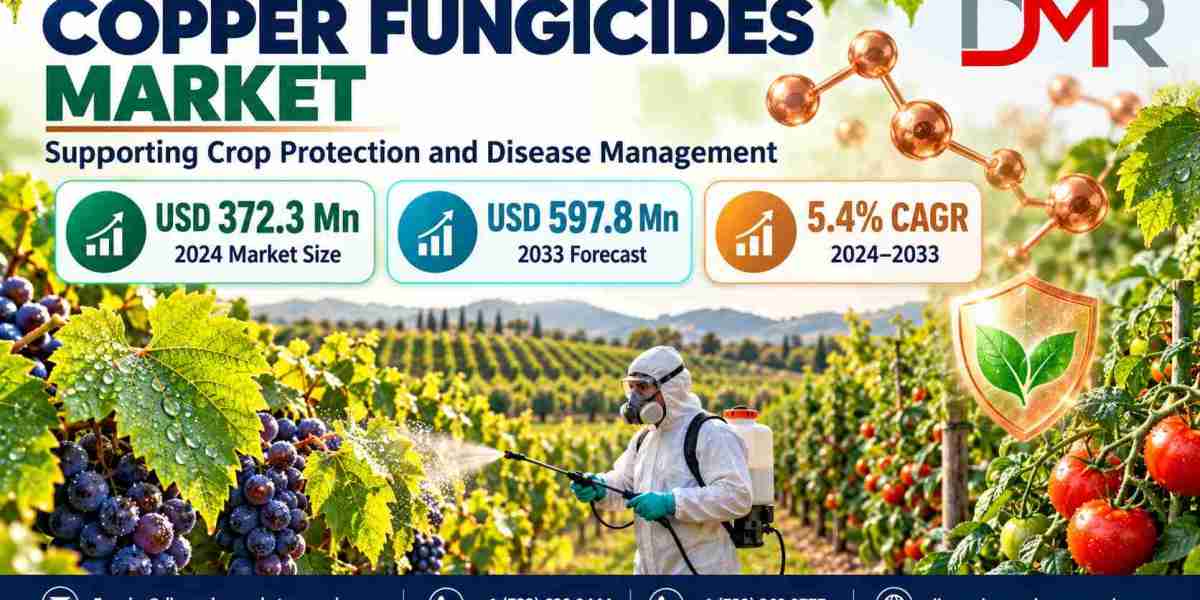

According to Dimension Market Research, the Copper Fungicides Market was estimated at USD 372.3 million in 2024 and is projected to reach USD 597.8 million by 2033. The report’s overview states a 5.4% CAGR alongside these endpoints.
For agricultural input suppliers, distributors, and investors, the practical question is where this outlook translates into a defined commercial opportunity. Market growth provides context, while individual investment decisions require a closer assessment of the intended crop, formulation, customer group, and geographic market.
What Is the Copper Fungicides Market?
The market covers copper-based crop protection formulations used against fungal diseases. DMR segments it by chemistry, formulation, and application, including fruits and vegetables, cereals and grains, and oilseeds and pulses.
These dimensions provide different perspectives on the same market. Chemistry identifies the product category, formulation describes its commercial form, and application organizes demand around crop groups.
For business readers, distinguishing these perspectives helps make research more actionable. A manufacturer assessing a product portfolio needs a different analysis from a distributor evaluating customer coverage or an investor reviewing a potential partnership.
Connecting Crop Protection Demand With Commercial Priorities
The report identifies crop protection needs, fungal disease pressure, food security, and formulation development as factors influencing the market.
These findings suggest beginning with a specific customer requirement. Which crop group would the proposed offering address? What problem does the customer need to manage? What evidence would support selection of that product?
A commercial assessment should connect those questions with a clearly defined offering. Broad participation in crop protection does not establish the obtainable opportunity available to an individual supplier.
For business development teams, the objective should be to identify the assumptions that need further research. That creates a more useful foundation for customer interviews, distributor discussions, and product planning.
Get a Free Sample of the Copper Fungicides Market Report
Explore the report’s structure and assess how its categories align with your research priorities. Reviewing the sample can help frame questions about chemistry, formulation, crop applications, regional markets, and competitive positioning before developing a detailed commercial assessment.
https://dimensionmarketresearch.com/request-sample/copper-fungicides-market/
Leading Chemistry and Application Categories
DMR projects copper oxychloride to account for 37.1% of its chemistry segment and fruits and vegetables for 43.6% of applications in 2024. Water-dispersible granules are identified as the leading formulation.
These are findings associated with the report’s 2024 estimate year. They should retain that date when used in presentations, articles, or business proposals.
The percentages also represent separate segmentation dimensions. They cannot be combined into a single market share calculation.
For suppliers, the findings offer a starting point for examining portfolio relevance. For distributors, application analysis can help organize further customer research. Neither finding establishes that one product or formulation is appropriate for every crop or purchasing situation.
Formulation Assessment Should Support a Defined Objective
A useful product assessment should explain what the business wants to compare. The objective might be to review a portfolio, identify a potential supply partner, or understand the requirements of a target customer group.
Before comparing proposals, establish a consistent scope. Ask suppliers to specify the product identity, supporting documentation, commercial terms, and responsibilities included in their offer.
This approach helps keep discussions concrete. It separates the market opportunity from the evidence needed to assess an individual product or partnership.
For investment planning, the same discipline applies. A proposal becomes easier to review when it explains the intended customer, the reason for selecting that customer group, and the assumptions supporting the commercial case.
Europe’s Position in the Published Outlook
Europe is projected to account for 61.9% of the market in 2024, making it the leading region in DMR’s analysis.
Regional leadership provides context for prioritizing research. It does not, by itself, establish a market entry strategy.
Businesses considering geographic expansion should connect the regional outlook with country-level customer research. Which buyers would the offering serve? Which partners would be relevant? What additional information is needed before a commercial commitment?
Keeping the estimate year visible is particularly important when comparing this report with other market studies. Matching definitions, dates, and geographic scope makes comparisons more meaningful.
Competitive Landscape
Report-listed participants include BASF, Bayer CropScience, UPL, Syngenta, Corteva Agriscience, Nufarm, ADAMA, FMC, and Sumitomo Chemical.
For competitive intelligence, compare relevant offerings against the same commercial objective. A broad company list becomes more useful when it supports a focused assessment of products, customer coverage, or potential partnerships.
For alliance research, distinguish direct competition from complementary capabilities. This can help business development teams identify which organizations merit closer discussion and what evidence should guide those conversations.
Future Outlook: Turn the Forecast Into Research Questions
The forecast provides a framework for planning through 2033. Businesses can use that horizon to structure portfolio reviews, customer research, and partnership assessments.
The next step should be specific. Define the decision, identify the information still required, and establish how that information will be evaluated. This keeps market intelligence connected to practical commercial priorities.
Explore the Complete Copper Fungicides Market Analysis
Review the forecast, chemistry categories, formulations, applications, regional outlook, and competitive context together. Align the research with a defined objective to support more focused discussions about product strategy, customer prioritization, or geographic expansion.
https://dimensionmarketresearch.com/checkout/copper-fungicides-market/
FAQs
What market size does the report estimate for 2024?
USD 372.3 million.
What is the forecast value by 2033?
USD 597.8 million.
What growth rate does the report overview state?
A CAGR of 5.4%.
Which chemistry category leads?
Copper oxychloride, with a projected 37.1% share in 2024.
Which region leads the market?
Europe, with a projected 61.9% share in 2024.
Conclusion
The published outlook connects copper fungicide demand with crop protection requirements and formulation development. For suppliers and investors, the practical opportunity is to connect those themes with a defined customer and product proposition. Clear segmentation, dated market figures, and focused commercial research can support better-informed business decisions.